16 Mar Charles ‘Chuck’ Tralka – Founder and CEO of ZeroQuest Energy

Matthew Sullivan
On Hooked On Startups today, we have Chuck Tralka, who is the founder and CEO of ZeroQuest Energy. Now, I’ve been looking through all of the descriptions of what ZeroQuest Energy does, but I think I’m going to hand it over to Chuck, and you are going to tell us what ZeroQuest Energy is all about.
Chuck Tralka
Okay. So in setting up the company, I had decided that I wanted to do something related to energy efficiency or clean energy and as basically a way to make a positive mark on the world. And I did a research actually for about a year and a half looking into different options and things where I thought a solopreneur could have an impact on the market. And what I came across was that refrigerated facilities are extremely energy intensive. In fact, buildings, which account for about 10 or 11% of energy usage across the US within that category, refrigerated facilities can use four to five times as much energy on a per square foot basis as just a regular commercial building, which isn’t too surprising. Refrigeration’s extremely energy intensive. So I zoomed in on that area as an opportunity for improvement. And as I began to investigate it more deeply, I found that energy refrigeration equipment tends to be installed, managed, and optimized for reliability, which makes perfect sense.
Typically, the refrigeration’s being used for keeping food cold and reliability is understandably a top priority. The problem is that typically those facilities are not optimized and not managed for energy efficiency, which is surprising because the utility bills are a significant expense for the people who have those kinds of facilities. So look like a good opportunity for optimization, and it’s a large space. There are tens of thousands of grocery stores and thousands of cold storage and food processing facilities across the US, and didn’t really look like an area where people were doing very much to optimize it.
Matthew Sullivan
And the biggest question really is how do you optimize a system that has been inherently built not to be optimized?
Chuck Tralka
Yeah, that’s a good question. So it turns out that there are some fundamental things. Let’s just start with how utilities charge for electricity. Commercial customers have a different billing structure than most residential customers. They get charged. If you look on a typical commercial utility bill, you’ll see a number of charges, but the two biggest ones, the first one is just number of kilowatt hours used, which is the same as for a residential bill. But the second biggest category for most commercial customers is a thing called peak demand charges. And it’s a reflection of the highest amount of electricity used in a single 15-minute period over the course of a month.
And it turns out that if you happen to have a lot of equipment turning on at the same time in that same 15-minute interval, then you can have a large, what’s known as a peak demand spike. And the peak demand spike, it basically represents there’s a charge that the utility puts on there for essentially having the capacity to support whatever largest load you’re going to present to them during the month. And that charge can be as much as 40% of the overall electricity bill for a commercial building. And we’re talking six-figure bills typically in the case of an average grocery store or possibly even seven-figure bills in the case of a large commercial cold storage facility or food processing facility. So these are already expensive bills and this peak demand charge can pop up and be a significant monthly expense. And it’s something that most of these operators don’t even understand what it is.
Matthew Sullivan
So just to recap, so we can completely understand, you’ve got two charges. You’ve got the usage charge, which is a per kilowatt hour, and then you’ve got effectively an availability charge. So in other words, we’re going to make sure that the grid is sufficiently stuffed with energy from all sorts of different providers all over the state, from batteries and different types of power generation facilities to make sure that if you need this huge demand to switch on all of your compressors, all at the same time, it’s there. So that is a big piece of someone’s built, and you say up to 40%. So the solution, obviously I can see that the solution is how do you minimize those peaks?
Chuck Tralka
Right, exactly. So that’s really where we focus initially because it’s an operational change and an equipment timing issue, not a capital cost kind of project. And so the ROI can be huge, and it really boils down to things like compressor staging. A typical heavily refrigerated facility will have multiple compressors for the refrigeration, and part of the trick is you want to make sure that all those compressors don’t turn on at the same time, which happens surprisingly often. And it’s actually not necessary for the reliability of the refrigeration. It’s just a convenient way for the refrigeration contractor to manage the installation. And it turns out commercial refrigeration also has other things going on. For example, there are defrosting events that occur, and those are essentially heaters, electric heaters that turn on to evaporate, accumulated or potentially accumulating ice, and they can turn on multiple times a day and also turn on at the same time themselves and occasionally at the same time as the compressors turn on-
Matthew Sullivan
Which is probably not terribly efficient, I would’ve thought, to try and cool a place you’re trying to heat at the same time. Exactly.
Chuck Tralka
Yeah. And then layered on top of that, you can have other things going on. For example, if you’re managing a grocery store, you may have your air conditioning turning on at that time. And so really a lot of the peak demand management just comes down to staging all of the various systems inside of your store so that they don’t happen to turn on at the same time.
Matthew Sullivan
There’s a couple of things I want to just throw out there. First of all, there’s a lot of intelligence that’s required in terms of intelligence. And I mean by the ability to process the data that you get from the various different parts of the installation and come up with a plan as to how do you achieve the type of refrigeration levels that you need with the equipment that you’ve got in an efficient way. So there seems to be a very good case to leverage some of the AI tools that are out there to do that. And the second thing is really, does ZeroQuest provide an ongoing type of configuration or ongoing type of polling where you’re constantly sort of talking to the systems and you’re talking to the environment remotely to find out what today’s demand is. Because if you’ve got tons of stuff in your refrigeration plant, then the demand for refrigeration is going to be higher than if you’ve just got somebody wandering around with a broom trying to sweep it clean.
Chuck Tralka
Right. Okay. Yeah, a lot of good questions there and all things that we’ve considered and built into our business plan. So first of all, a surprising amount of the optimization can be done just simply by analyzing where these peak occurrences are happening. And that information is actually available inside of the utility data. So each of these clients that we have has their utility recording their demand on a 15-minute interval basis, twenty four seven, 365 days a year, and that data is actually available to us to analyze. So one of the first things we do when a client comes to us is we ask just for a most recent utility bill, scan that and we look for obvious signals that they’ve got these peak demand charges, which usually pops up pretty quickly. And then the next step is for us to download this 12 months of 15-minute interval data and analyze that.
And then we can tell when these peaks are occurring, we give that feedback to the client’s refrigeration contractor and we just tell them, “Go in and make the following changes to the controls on the refrigeration equipment.” And all of this stuff is controlled by fairly sophisticated electronic controllers already.
It’s not coordinated, it’s not managed. And so the first thing we do is we just apply some human intelligence and tell the refrigeration guy, “Hey, go in and make the following changes.”
Chuck Tralka
Yeah, right, exactly. Yeah. It’s AAI or HAI. So that’s the first step. Now, as you mentioned, ongoing monitoring can be extremely valuable here and for two reasons. One, we can see a peak event occurring or beginning to occur before it fully develops and alert the owner, alert the refrigeration contractor, and so we can do some prevention that way. But more importantly, what tends to happen to a store over time is even if you optimize it, it’ll slowly lose that optimization because another contractor comes in, they install a new piece of equipment, they forget about the optimization that you had done previous- Isn’t that the law of entropy applies to
HVAC? Yeah, it’s entropy, it’s classic entropy in action. And so one of the services we offer is a monthly monitoring service. And in fact, when we do an initial evaluation, we build in the first six months of monitoring for free just because we know it’s going to be necessary. And then we’re pretty comfortable that most of our clients will continue with that once the free period ends. Now, looking forward, as the company evolves, we’ll become more and more proactive about managing the events using AI within the building. And there’s some really interesting things you can do.
If you think of a refrigerated facility like a giant thermal battery, then one of the things you can do … Most utilities tend to charge more money in the afternoon than they do in the mornings or in the evenings, because that’s when their peak demand is happening. Yeah. And that’s actually a different form of peak charges, but it’s usually known to the utilities or by the utilities as a time of use charge. And so for example, if we know that a day is going to be a particularly hot day, then we can program the refrigeration to pre-cool in the morning or even overnight. By just a few degrees, it doesn’t really have to be that significant. And then essentially you can coast through the afternoon while the temperature slowly rises within the refrigerated space, but still stays comfortably within food safety parameters. And by doing that, you’re basically shifting your energy, your electricity consumption from the afternoon when it’s expensive to the morning when it’s cheap. And so small changes like that can also have a big impact on the overall electricity bill.
Matthew Sullivan
In the same way that the HVAC contractor is probably able to dial in, to quote a phrase, to their system control panels for various
Chuck Tralka
Different. Yeah, exactly. Are you able to do that or is there an antiquated software or are there privacy issues or copyright issues or licensing Issues or …
Chuck Tralka
No, all of that stuff is completely doable with the technology available today, and there really aren’t any ethical, legal, or even technical obstacles in the way of doing that. It’s just that we’ll start from a monitoring standpoint and then slowly grow into more of a control platform standpoint. And with AI, there’s a ton that we can do. For example, you could have your AI layer looking at weather forecasts and controlling a base of users so that as the … Again, if you think it’s going to be a hot day, you can pre-cool, but also utilities can send demand signals. There’s a thing called demand response where you can sign up with a utility where, for example, on a hot day, they may want a group of customers to voluntarily cut back their electricity consumption and they’ll pay you for that privilege. So we can use our knowledge of what’s happening inside of that facility.
And again, refrigerated facilities are great candidates for demand response programs because they’re such heavy users of electricity.
Matthew Sullivan
Tell me a bit about the scale of customers and the range. You mentioned grocery stores and refrigeration plants. I mean, so what’s the range of customers you have?
Chuck Tralka
Right. Yeah. So for example, a typical convenience store is probably a little bit too small for these kinds of implementations to be cost-effective.
Matthew Sullivan
They’ve got a fridge, basically.
Chuck Tralka
Yeah, right, exactly. But once you get up to about a medium-sized grocery store and up, and especially certain types of grocery stores that, for example, if one of the things we look for, does a grocery store have a dedicated meat and seafood refrigerated counter? In addition to all of their other stuff, do they have food preparation on site where there are probably ovens and other things going on and additional refrigeration there you’ve got to keep things hot and cold. And so there’s even higher electricity use on a per square footage basis. And typically we look for a store that has $10,000 a month or higher electricity bills, which in a high cost of electricity state like California is extremely common. And it’s very, very easy for us to find grocery stores that fit that category. Once you go to cold storage and food processing facilities, pretty much every single one of them is a good candidate for these kinds of optimizations.
Matthew Sullivan
And you mentioned California being the primary state, because obviously that’s where you are based at the moment.
Is this something that is state dependent? Because the way that electricity operators provide their infrastructure differs from a state to state basis. So this is a two-part question. The first part is, is your process more optimized for certain types of energy billing? And secondly, is there an opportunity to provide a source of energy on a competitive basis? So not only can you provide energy management for their biggest energy overhead, are you potentially able also to offer them the energy as a supplier? Because I know certainly in some states the markets are deregulated. So is there a potential for you to become an energy supplier as well, which means that you can actually build in a completely different type of billing structure, which doesn’t rely on the traditional billing implications that you talked about before.
Chuck Tralka
Right. Yeah, great questions. So on the first one, there is a state-to-state difference. California can be as much as three times higher than the US average electricity cost. So this state is what we would call a target-rich environment and has, I think, about 11% of the US 12- And it’s normally pretty hot in California, so there’s-
Chuck Tralka
And there’s that. Yeah. So it turns out that weather is also a big component, and another big component beyond just cost per kilowatt hour is how does the particular utility in that area structure their billing?
Matthew Sullivan
Yeah, exactly.
Chuck Tralka
There are utilities in lower cost of energy states that have high peak demand charges, and so those clients can also be good candidates for this model. So while it’s true that there won’t be, not every grocery store in every state is going to be a good candidate, there are quite a few, just starting with California and a few other high costs of electricity states like New York and the New England area, Hawaii is another one, but also states with high peak demand charges. And then as you mentioned, states where it gets hot, there are good candidates in Arizona and Nevada, even though their cost of electricity is lower, cooling food and people in a grocery store in Phoenix in the summer costs a lot of money even if the electricity’s cheap. So yeah, there definitely is good potential in other places as well.
Matthew Sullivan
And what’s your proposed route to market? Is it working with the, obviously probably not the energy companies, but is it working with the grocery stores as a group like the Ralphs and the Kohls or is it more focused on the equipment providers? Because presumably the equipment providers, they tend to be probably more fragmented, I would’ve thought, in terms of the actual installation companies-
Chuck Tralka
Yeah, so there really are multiple layers. There are the refrigeration equipment providers themselves where we probably won’t focus as much effort. And then the next layer are the refrigeration contractors, the guys who install and maintain the equipment. Those are actually quite a good channel for us. And I’ll be going to a show called the IAR Show this coming weekend. Well, actually it starts Monday. And part of my objective there is to meet those refrigeration contractors who are servicing the grocery stores, but also the cold storage locations. And then there’s that third layer, which is the client base itself, the grocery store owners and the cold storage and food processing facility owners. And our strategy really is to start with the smaller independent guys. For example, the grocery stores, we’re talking to one right now that has three locations in San Jose, and they’re quite a good candidate because any work we do can be leveraged over multiple stores, yet their management is local and accessible.
And so I think what will happen for ZeroQuest is we’ll start with smaller chains and then slowly move our way up the food chain, so to speak, to the larger guys. And ultimately we can offer significant services to even the largest chain grocery stores.
Matthew Sullivan
And this is a great product for independent distributors and independent servicing companies because presumably there are revenue share opportunities as well
Chuck Tralka
Exactly. Yeah. And that’s going to be part of our strategy is to work with the refrigeration contractors and there’s some others, which I’ll get to in a second, but starting with them, because we can offer the ability to go to their clients and identify when there’s work that needs to be done for the refrigeration guys. And what tends to happen right now is that there are a lot of fire drills because if a compressor fails and the ice cream’s melting in a grocery store, the refrigeration guy’s got to get out there right away. It’s probably more of an ice drill as opposed to a fire drill. Yeah, exactly. That’s right. It’s a melting ice cream drill. And that’s really not good for anybody. The client ends up paying extra because it’s an emergency visit.
Matthew Sullivan
If you’re constantly monitoring efficiency of units, presumably you can tell when efficiency begins to tail off, which means that it probably indicates some sort of equipment where-
Chuck Tralka
Exactly. So we’ll start by just monitoring utility data, which is what’s happening at the meter, and there’s a surprising amount of information available there, but then we’ll grow into monitoring data directly from the refrigeration equipment, power draws on a per compressor basis, temperatures that are being recorded inside of the refrigeration equipment, and being able to see exactly when the compressors are turning off and on and we’ll be able to look at things like suction head pressure, which turns out to be an important efficiency metric. And so ultimately, we’ll just have a huge amount of data that we’ll be watching over on a day-to-day basis for each of these guys, and that will allow us to identify, for example, a pending compressor failure as one example. And then we can tell the contractor, “Hey, get out there on Monday and get this thing replaced.” And that’s better for everybody because the refrigeration contractor gets the work, but they get it on a managed scheduled basis instead of on a fire drill basis.
And the store owner gets lower costs ultimately because this stuff is being proactively managed instead of just reactively managed.
Matthew Sullivan
And how do you get the word out? If you’ve got such a great product, and there’s huge demand because effectively you’re saving people money, you’re saying with presumably very little, there’s no capital cost, as you said earlier, but how are you going to … What’s your marketing strategy? In other words, I think we discussed
Chuck Tralka
That what I mean,
Matthew Sullivan
How are you going to get to service all these people? Is there something that they can do on a self-service basis? Can they download software? Can they plug … Can they use some sort of application?
Chuck Tralka
Well, yeah, ultimately there will be a software platform, but today there’s a website and the easiest way for people to engage with us is just simply visit the website and there’s a button there that says, “Get my free energy evaluation.” And so all they have to do is click on that and we can start working with them. But right now, what I’m focused on is bringing in the initial case study customers, which will likely be local grocery stores who I’ve talked to directly, and we’ll be able to demonstrate just from analyzing their utility bills, the kind of improvements that we can make for them. Now there are also, I should point out, we have the ability to evaluate capital investment projects as well, and so installing solar, installing batteries, upgrading electrical panels, adding new control equipment. In some cases, we can even recommend whether particular refrigeration equipment should be replaced just because it’s just too inefficient.
And we can do all the calculations to show what the ROI is likely to be for the customer in each case. And so part of the model is not just us doing this energy optimization, but it’s what I call being an energy partner for the customer. In other words, these guys, and I’ve talked to a bunch of them, they’re really Super busy managing a typical, even a small grocery store stocks tens of thousands of items. They run on fairly slim margins. And so they’ve got to manage their business very carefully on a day-to-day basis, and it takes an incredible amount of effort and focus. And they really just don’t have time to spend on managing their energy. As I mentioned, a lot of them, they get the bill, they see it as a necessary expense. They write the check and they move on. But what we can do is we can be their energy advocate and we can tell them, “Hey, you should look at this.
Do solar, don’t do solar, do a battery, don’t do a battery.” And we can give them all the numbers. And even another service that we can offer is we can work with the utility on the client’s behalf. In some cases, there are utility incentive programs that are available. I was just going to say
Matthew Sullivan
Actually, because historically utilities will send you boxes of fluorescent light Bulbs to replace your incandescent bulbs and then claim some sort of massive government subsidy as a result. Are there any similar types of programs where if you can demonstrate that your product will create a significant reduction in energy consumption, are there incentives or other types of processes that you can tap into?
Chuck Tralka
Right. And so California alone has dozens of different utilities. There are three large ones that are, they’re called the IOUs, the investor-owned utilities, but there are a ton of smaller municipal utilities and they all have different programs for different purposes. And navigating that is complicated and confusing to most of our clients.
And as a general rule, they just throw up their hands and go, “I don’t have time for this. ” So navigating that whole landscape is something that we can help with. And if there’s money out there available for some of this work, whether it’s solar or battery or buying new refrigeration equipment or installing LED lighting or whatever, we can identify that to the client and we can show them, “Hey, with the utility incentive, here’s what the ROI to you actually looks like. ” And then let the client make a good decision. But we can convert all of that confusion into clarity and make it really easy on these business owners who, again, are really focused on managing their day-to-day business.
Matthew Sullivan
And probably just don’t realize that there’s so much because from a margin perspective, I know I think in your book, which you recently published, which we can talk about in a moment, but I think in your book you mentioned the impact is very much at a profitability level as opposed to a revenue level. So in other words, if you’re operating on very low margins, two, three, 4% margins, then a saving of a thousand dollars is the equivalent to a $25,000 revenue.
Chuck Tralka
That’s right. Yeah. So grocery stores are often run promotions or whatever so that they can get this marginal increase in grocery sales, which makes perfect sense. But actually, if we can save them, for example, $20,000 a year, at a 2% margin, we’ve got basically 50X leverage, and so that could be the equivalent of a million dollars in additional grocery sales.
Matthew Sullivan
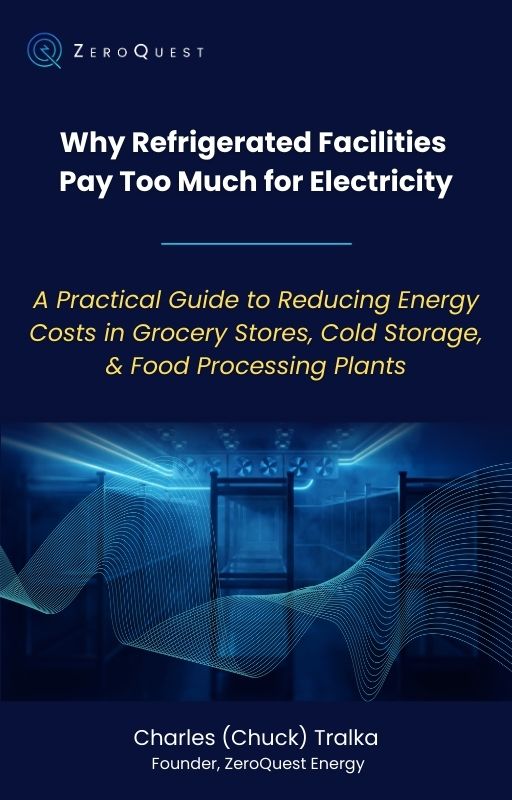
Bottom line stuff. And this is obviously why you published the book, which is why refrigeration heavy facilities pay more for electricity than they should, which is obviously compelling. A sort of “everything you’ve ever wanted to know about refrigeration, but we’re afraid to ask”. It’s a serious book, but in terms of the amount of information that it contains, is that something that you’re going to be promoting when you are at these trade shows?
Chuck Tralka
But we’ll be actually making the book available on Amazon this coming week, so excited about that. And yeah, it’s more … I wanted to get a reference book out there because there really hasn’t been anything published that I’ve found on this topic. And I’m not sure that most grocery store owners are going to have the time to read it, but there is a lot of good information.
Matthew Sullivan
But you don’t need to read. It’s not like a novel.
Chuck Tralka
Yeah, exactly. But I think it will be very useful to refrigeration contractors who, again, have been trained their whole life to focus on reliability and with energy efficiency is really a secondary thought, and maybe not even that. And also, again, for people who run refrigerated facilities like a cold storage warehouse or a food processing plant, for those guys, energy, it can even be their number one expense, but certainly number two. Yes. Yeah. Yeah, exactly. And so I think that information can be very valuable to the people who are able to dedicate a little bit more time to understanding this topic.
Matthew Sullivan
And sort of final-ish question, because it is an astonishingly interesting subject because it’s like all of the truly interesting subjects, they’re staring you in the face and no one really sees them until someone says, “Oh, by the way, you’ve got this sort of giant pimple on your nose, which is the equivalent of this sort of energy bill.” Was there a moment where you woke up in a cold sweat at three o’clock Monday morning going, “This is my aha moment, this is my eureka moment.” Or was it a process like that, or was it really just driven through just analysis and looking for where the gaps are?
Chuck Tralka
Yeah, it was probably more the second. It was a long process of evaluating a huge space. Absolutely. And one of the challenges, I knew I wanted to do something in clean energy, but one of the challenges was there are a lot of really, really smart, really well-funded people working on just about every topic that you can think of. And I looked at everything, electrical, vehicle charging, hydrogen, production and transportation, and various solar-related businesses. And the problem was these are all very well understood, well-funded problems. And so I slowly gravitated towards energy efficiency because it’s one of those things that’s boring and it’s not the type of thing that tends to attract
Matthew Sullivan
The best businesses are the most boring businesses.
Chuck Tralka
Yeah. It’s not the kind of thing that tends to attract money and really bright people. And I also, one of my criteria, as I mentioned at the beginning, was something that I thought an individual entrepreneur who is essentially bootstrapping their own company because I thought a lot too about, do I want to do a VC funded approach? And the more I looked at things, the more I … And also given the stage of my life, I realized I wanted something that I thought was going to be a really solid base hit rather than a one in a thousand shot at a unicorn valuation as opposed to posted the moonshot. Yeah.
Chuck Tralka
Yeah. Right, exactly. Yeah. So that’s part of how I landed here. And then I realized this is not … And I actually started with energy efficiency for small businesses in general, but got some good advice from another very successful entrepreneur to focus on, who’s now an advisor to my company, to focus on the segment of the market where the pain is acute to use his words and refrigerated space is definitely where the pain is acute. Well,
Matthew Sullivan
Energy bills, it feels pretty acute every time you get the bill.
Chuck Tralka
Yeah. Right. Yeah. And for these guys, it’s 10 times worse than for the average.
Matthew Sullivan
Well, actually, no, it’s a chronic illness with acute episodes.
Chuck Tralka
Right. Yeah, exactly. Yep. And it’s likely to only get worse
With data centers coming online. For a long time in the US with energy efficiency programs, even though the population was growing, the economy was growing, overall energy demand has been relatively flat because of increasing efficiency, things like switching from incandescent to LED, light bulbs is a good example, but just in the last few years, the total demand has started to go up again and the utilities really were not prepared for that. And as a result, there’s a huge backlog of upgrades and capital investments on their side, and that cycle is really just starting now. And as they enter into that, we’re all going to see higher utility bills as they’ve worked to recoup their costs there.
Matthew Sullivan
Timing sounds perfect. And with all the tools that you have, with obviously the increased efficiencies that AI brings, you’ve got much greater processing and sort of investigatory abilities at your disposal.
Chuck Tralka
That’s right. Yep. Yeah. All of the technology is available to address this problem today, and it’s really just a matter of focusing it and bringing it to bear on a problem that’s been there for a long time that just until now, nobody’s really done anything about.
Matthew Sullivan
A perfect storm. Fantastic. Good. Right. Well, we will then switch gears slightly just before we wrap up. I’m not sure, Chuck, if you remember, but at the end of all of my podcasts, we like to dive into the hooked on startups quickfire questionnaire.
Matthew Sullivan
So, some very silly questions, some of which you may want to answer and some of which you may not. So the first question is Chuck Tralka, CEO and founder of XeroQuest Energy. What is your favorite word?
Chuck Tralka
My favorite word is cerulean.
Matthew Sullivan
Fantastic. Yeah, that’s a winner. And what is your least favorite word?7
Chuck Tralka
I’ll use the French version, Merde.
Matthew Sullivan
And what are you most excited about right now?
Chuck Tralka
I don’t mean to keep pitching ZeroQuest, but I’m actually quite excited about the potential for this company. So I really look forward to working on it every day when I wake up.
Matthew Sullivan
Oh, wonderful. And what turns you off right now?
Chuck Tralka
Political polarization in the US.
Matthew Sullivan
What sound or noise do you love?
Chuck Tralka
I’m a bird watcher and known in the community as a birder, and my wife really likes to attract birds to our yard. So the hearing a bird song in our yard in the morning.
Matthew Sullivan
And what sound or noise do you hate?
Chuck Tralka
Oh, I’ve got a good one. Since I work from home most of the time, in our neighborhood, it’s very common for people to hire gardeners and they all tend to use these gas powered leaf blowers. And I’ve learned to just come to despise those because- Well, they’re timed to be used and switched on just as you’re about to go onto a call or a conference.
Matthew Sullivan
So the next question, which you may or may not answer, is what is your favorite curse word?
Chuck Tralka
I don’t have a good answer for that one.
Matthew Sullivan
That’s fair enough. What profession, other than your own, would you like to attempt?
Chuck Tralka
Well, when I was a lot younger, I had thought I would really like to be a medical doctor. And so I think in another life, that might’ve been something that I would’ve pursued.
Matthew Sullivan
My next question. What profession would you not like to attempt?
Chuck Tralka
I don’t think … When I was younger, my father encouraged me to consider a job with a local waste management company, just because the pay and the benefits were so good.
Matthew Sullivan
My final question, if heaven exists, what would you like to hear God say when you arrive at the Pearly Gates?
Chuck Tralka
You’re in the right place.
Matthew Sullivan
Fantastic. Chuck, thank you so much. It’s been absolutely amazing talking to you. Tell us finally, how do we get hold of you and how do we find out more about ZeroQuest?
Chuck Tralka
Okay. Super easy to email me. It’s Chuck.Tralka@zeroquestenergy.com. And the website is www. zeroquestenergy.com.
Matthew Sullivan
That’s fantastic. It’s been a pleasure. Thank you so much and look forward to following your progress.
Chuck Tralka
Thank you so much. Talk to you later, Matthew.
Matthew Sullivan
Thank you.